





Related news
Silk Scrunchie Elastic Guide: Stretch, Recovery, Hold & Construction Explained
A scrunchie looks simple, but its hold is a compact engineering system: elastic force, silk dimensions, seam friction, and recovery must work together. For brands sourcing silk scrunchies, the useful question is not simply “How tight is it?” but “How will this construction behave after repeated stretching, washing, and custom printing?”
How Silk Scrunchies Create Secure Hold
Loop Circumference and Elastic Tension
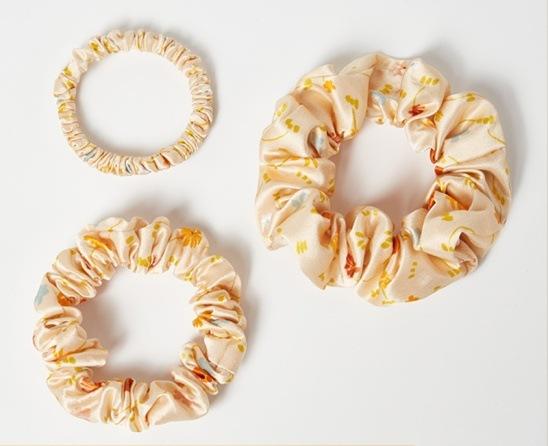
Hold comes from the balance between the elastic’s retractive force and the finished loop circumference. A shorter loop creates more tension around a ponytail, while a longer loop feels gentler and accommodates thicker hair. The casing changes the sensation: a narrow silk tube transfers force directly, whereas a wide, heavily gathered tube spreads pressure across more fabric.
A supplier should record relaxed circumference, maximum working circumference, elastic width, and the number of wraps expected around the hair. These measurements make “light,” “medium,” or “firm” hold reproducible across sizes and colorways.
Silk Surface and Hair Grip
Silk does not provide the spring. It is a smooth, low-friction shell around the elastic, so the core and casing need separate specifications. Glossy satin may slide more readily on very fine, straight hair; twill or crepe de Chine can provide more surface texture. The right choice depends on hairstyle, hair density, and whether comfort or maximum grip is the priority.
Elastic Stretch and Recovery for Silk Scrunchies
How to Measure Working Stretch
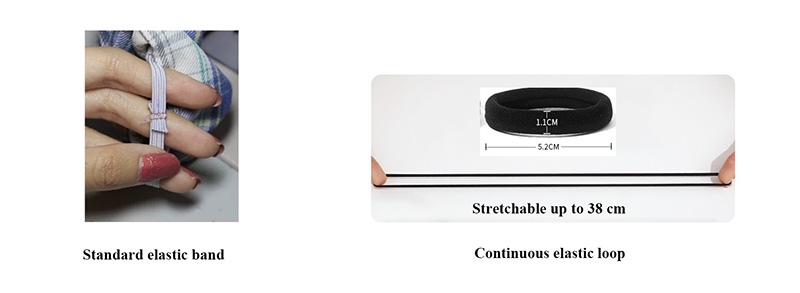
Stretch is how far the core extends under load. Instead of quoting only a maximum extension, define a working range that reflects normal wear. Measure the relaxed loop, extend it to the target circumference, hold it for a fixed time, and note the force required. Testing on representative hair bundles helps translate a laboratory number into a realistic number of wraps.
Why Recovery Matters More Than Maximum Extension
Recovery is how closely the elastic returns to its original length after release. A scrunchie can offer impressive initial stretch yet become loose after several uses if recovery is poor. Check the relaxed length immediately after cycling, after a rest period, and after laundering.
Ask for elastic composition, width tolerance, break strength, and cycle-test conditions. “High elasticity” without a method or tolerance is not a production specification.
Construction Details That Control Comfort and Durability
Casing Width, Gathering, and Silk Weight
The amount of silk around the elastic controls volume and pressure distribution. A narrow casing gives a compact profile; a wider casing creates fuller gathers and a softer feel.
Silk satin produces a glossy, fluid puff, silk twill adds body, and crepe de Chine creates a softer, slightly grainy surface. Momme should support the desired drape without making the accessory unnecessarily bulky or slow to dry.
Seam Security and Elastic Joining
The casing should be cut on a stable grain with enough seam allowance to stop the silk from pulling away from the stitching. A clean enclosed join prevents elastic ends from catching hair. Stitch density must contain the gathers without perforating the fabric, and the closing seam should lie flat.
During inspection, stretch the join repeatedly and check for thread breakage, puckering, exposed elastic, sharp label edges, and snagging.
Custom Print Placement on Gathered Silk
Designing Motifs for Folds and Rotation
A custom print silk scrunchie should be designed around gathering rather than treated like a miniature flat scarf. Small motifs may disappear in folds, while a large logo can rotate to the inside of the loop.
Build a repeat that remains recognizable at the relaxed circumference, include sufficient bleed, and inspect several orientations after sewing. A strike-off should show the darkest color, the smallest detail, and the seam area.
Choosing a Print Method and Approval Process
Digital printing is useful for gradients, photographic motifs, low-volume sampling, and several colorways. Screen printing suits simplified artwork and larger, stable runs, but every additional color adds separation and setup.
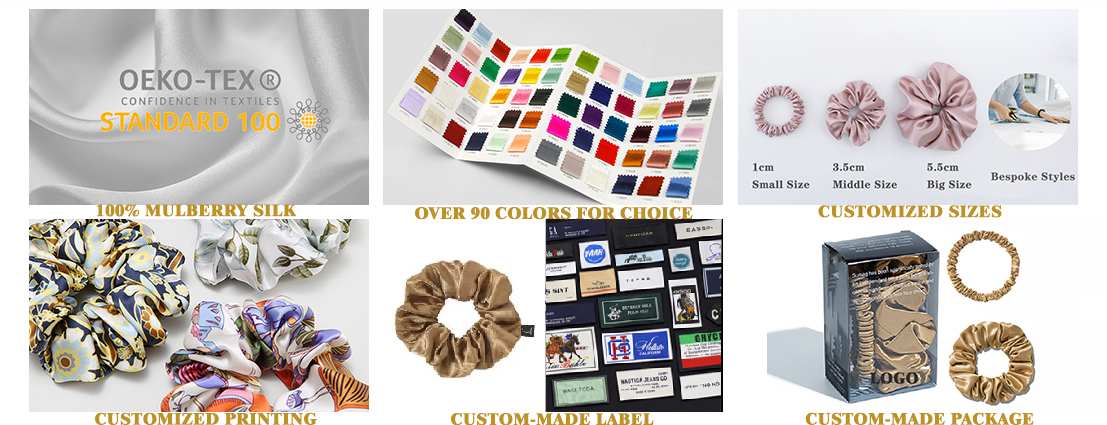
Zhigeng Silk develops custom-printed silk accessories using premium 6A-grade mulberry silk, OEKO-TEX-certified options, private labels, and packaging. Our workflow includes digital proofs, physical sampling, color checks, washing, finishing, and multi-point inspection.
How to Build a Supplier-Ready Scrunchie Specification
Measurements, Materials, and Tolerances
A good request for quotation for finished elastic for working and relaxed circumference states: elastic material, width, extension and recovery tolerance; silk fiber content, weave, momme and color; width of casing and gathering ratio; print method, repeat and position on garment and reverse print acceptable; type of seam, position of labels, packaging and scope of inspection.
State whether different sizes need different elastic rather than only different casing dimensions.
Sampling, MOQ, and Bulk Approval
Request a physical sample in the exact silk, print, elastic, label, and packaging configuration. At Zhigeng Silk, we describe sampling in the 7–10 day range and bulk production in roughly 14–20 days for comparable custom silk accessories; confirm current timing against quantity, season, and finishing.
Before bulk approval, test the sample on representative hair, cycle the elastic, wash it according to the care label, and check recovery the next day. Silk scrunchie MOQ should be reviewed together with colorway count and packaging complexity.
Troubleshooting Hold, Slippage, and Production Defects
When a Scrunchie Slips or Feels Too Tight
Slippage may result from an oversized relaxed loop, poor elastic recovery, too few wraps, or a very smooth casing used on fine hair. Excessive tightness may come from a short loop, narrow elastic, or force selected by break strength rather than comfort.
Diagnose the complete construction before changing only the elastic: casing bulk and surface texture also affect perceived hold.
Questions That Reveal Manufacturing Risk
Replace vague claims with measurable questions: What is the relaxed circumference tolerance? At what extension is recovery tested? How many cycles are included? Is the print approved on the final silk quality? Are defects classified by seam, elastic, print, measurement, and packaging?
A clear defect list allows the supplier and buyer to inspect the same product against the same standard.
FAQ
Q: How tight should a silk scrunchie be?
A: It should hold the intended hairstyle without pain or visible pulling. Specify relaxed circumference and test the number of wraps on representative hair thickness instead of relying on a universal size.
Q: Does silk stretch like elastic?
A: No. Silk forms the smooth casing, while the internal elastic supplies stretch and recovery. Both materials should be evaluated separately and as a finished construction.
Q: Are silk scrunchies good for your hair?
A: Yes. Their smooth surface reduces friction, which may help minimize pulling, tangling, frizz, and hair breakage.
Q: How can a scrunchie be stopped from losing its stretch?
A: Use elastic with documented recovery, avoid routine overextension, and follow the care label. For sourcing, include cycle and post-wash recovery checks in sample approval.
Q: Are custom printed silk scrunchies durable?
A: They can be when the print is fixed correctly, and the casing is tested after sewing and washing. Check crocking, color change, seam security, elastic recovery, and motif legibility in the folds.
Q: What should buyers ask a silk scrunchie manufacturer?
A: Ask for silk composition and momme, elastic specifications, finished measurements, print and seam tolerances, MOQ, sample timing, inspection criteria, packaging options, and the process for handling rejected units.

 consult
 WHATSAPP
 leave message
 top
top